2006/2008
found footage video
duration: 47’25”
from the series Game with Moving Mirrors – Part Three
collaboration: Michał Januszaniec
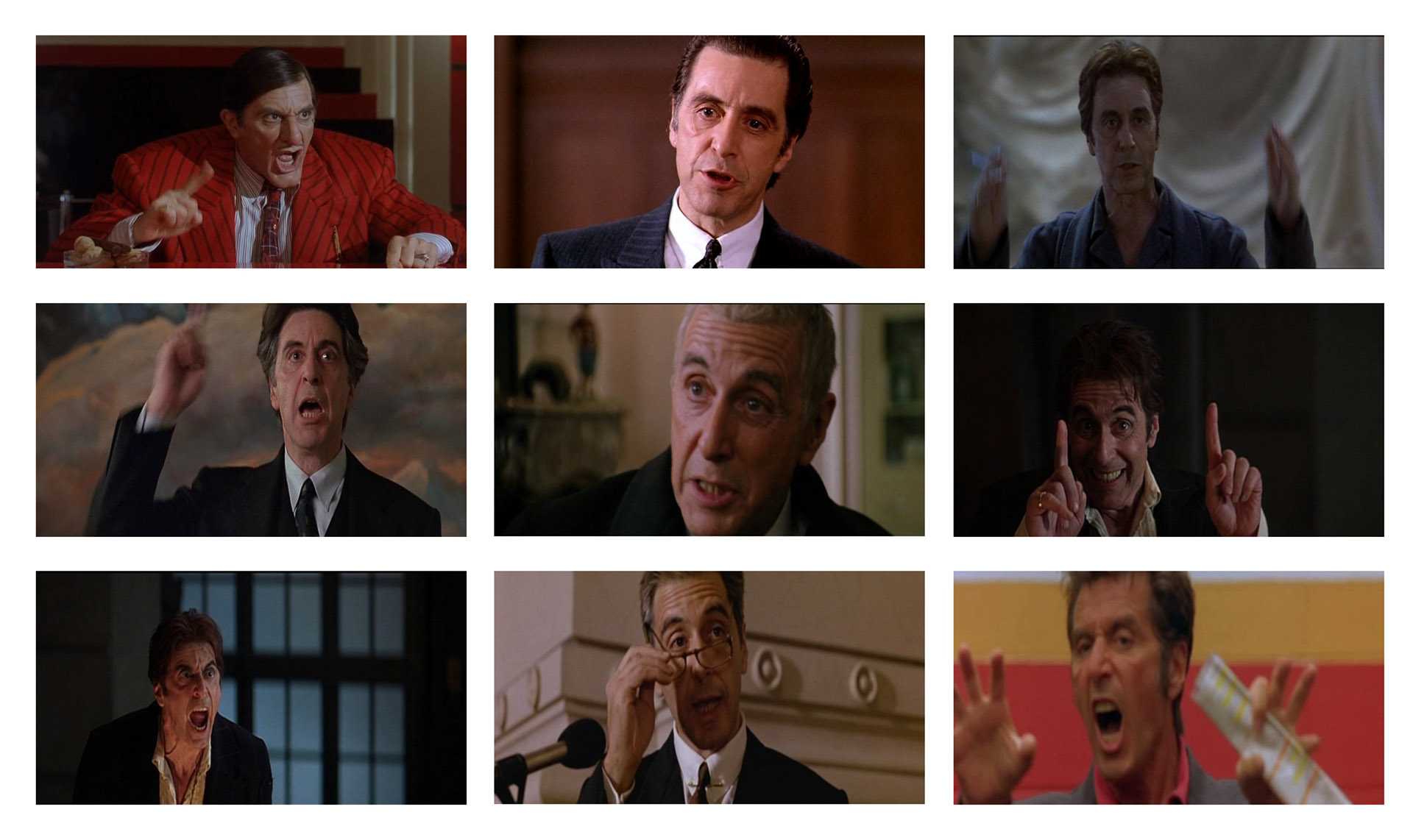
The disassembling and re-assembling of film narratives and images permits Burska to develop a discussion on the ways identity in popular and artistic cinema becomes image, as well as cultural phenomena related to identity as such. As an example, one can quote the work Shooting Star, which closes the series called Game with Moving Mirrors, and which has both a monographic and mythological character. The series is composed from fragments of films with Al Pacino, showing the repertoire of his incarnations and the possibilities of his acting style. This peculiar monograph is ordered by dominant traits, related to the types of personalities he has acted, their temperament, as well as the types of activities and functions which his characters play in the social sphere. A symbolic gathering of the actor’s filmography into one story makes both him and his output even more intriguing than if each of his roles were admired separately. The effect of the whole, based on juxtaposition and accumulation, corresponds to Burska’s desire to make them non-homogenous and ambiguous in total: “I strive for this ambiguity. I also want my work to be more than a mere collection of images – something which offers the same pleasure we enjoy while watching a film, a story”.
This creative presumption, expressed in such words, is linked to another, mythical dimension of Shooting Star, which both records an actor’s career and illustrates the American mythology of success. Using different images, Burska composes a hero of many faces, who actualises in various ways the model of masculinity based on career, status, dominance and power. The issue of masculine identity constantly recurs in films with Pacino, whatever the theme or genre of the films may be. Collecting all of these threads into one whole facilitates the game with cultural patterns, translated into stereotyped, popular images and cinematic plots. Therefore, found footage is the artist’s method of working with “narration and against it” in the mode of female directors-experimenters, which gives her the possibility of re-constructing cinematic codes of gender presentation.
excerpt from the text Games with Moving Frames by Małgorzata Radkiewicz, catalogue Films. Bogna Burska, ed. Aleksandra Grzonkowska, published by Wyspa Art Institute, Bunkier Sztuki Gallery of Contemporary Art, BWA Zielona Góra, and the Academy of Fine Arts in Gdańsk, 2014
sources:
88 Minutes dir. Jon Avnet
…And Justice for All dir. Norman Jewison
Angels in America reż. Mike Nichols
Any Given Sunday reż. Oliver Stone
Author! Author! reż. Arthur Hiller
Carlito’s Way reż. Brian De Palma
City Hall reż. Harold Becker
Cruising reż. William Friedkin
Devil’s Advocate reż. Taylor Hackford
Dick Tracy reż. Warren Beatty
Dog Day Afternoon reż. Sidney Lumet
Donnie Brasco reż. Mike Newell
Frankie and Johny reż. Garry Marshall
Glengarry Glen Ross reż. James Foley
Heat reż. Michael Mann
Insomnia reż. Christopher Nolan
Ocean’ s Thirteen reż. Steven Soderbergh
People I Know reż. Daniel Algrant
Scarecrow reż. Jerry Schatzberg
Scarface reż. Brian De Palma
Scent of a Woman reż. Martin Brest
Sea of Love reż. Harold Becker
Serpico reż. Sidney Lumet
Stardust reż. Matthew Vaughn
The Fabulous Baker Boys reż. Steve Kloves
The Godfather reż. Francis Ford Coppola
The Godfather: Part II reż. Francis Ford Coppola
The Godfather: Part III reż. Francis Ford Coppola
The Insider reż. Michael Mann
The Local Stigmatic reż. David F. Wheeler
The Panic in Needle Park reż. Jerry Schatzberg
The Recruit reż. Roger Donaldson
The Story of Us reż. Rob Reiner
The Witches of Eastwick reż. George Miller
Two for the Money reż. D.J. Caruso
What Lies Beneath reż. Robert Zemeckis
Wolf reż. Mike Nichols