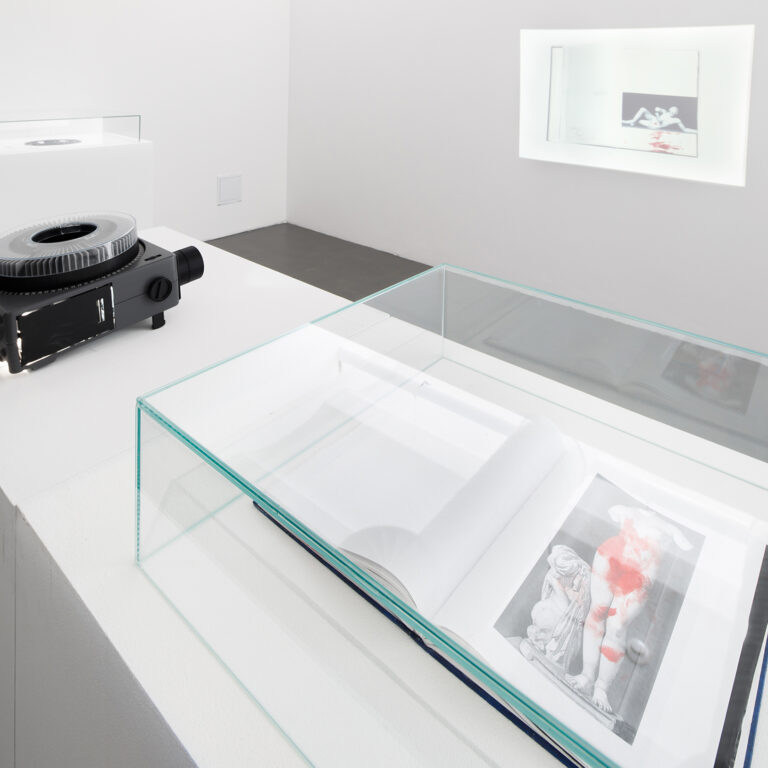
untitled
installation, 2001/2002

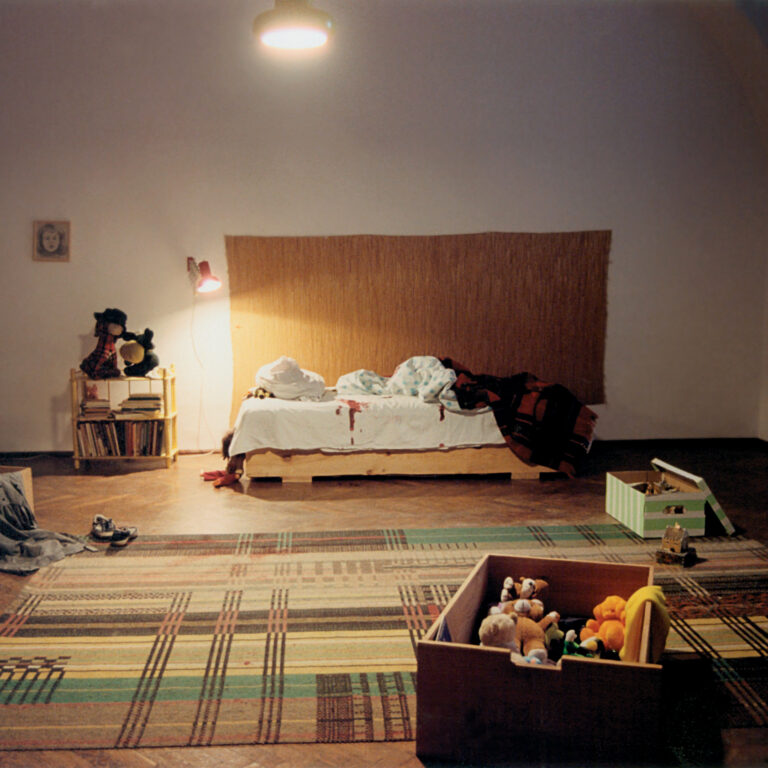
Bogna Burska’s installation presented in 2002 at Biała Gallery reveals the scenographic lavishness of her art as well as her talent for narrating grim, painful stories. In the gallery, staged as a living space, she placed a children’s bed. The bed linen was stained with blood. The viewer’s breath quickens, alarming images are generated. A familiar interior becomes subject to manipulation. An image of a typical bedroom turns into a horrifying three-dimensional photograph of a crime scene. This is how diabolically powerful models of reality are created and demons awakened without resorting to any complex techniques. The artist does not have to use real blood or the odour of a dead body to attract the viewer’s attention.
Burska’s method may be compared to the activity of the American police officer and researcher Frances Glessner Lee. In the 1930s she developed a project of building strange, miniature houses. The models were reconstructions of crime scenes committed in Chicago at the turn of the nineteenth and twentieth centuries – at that time, the city was witness to many unsolved mysteries. The miniature houses were designed to help detectives solve those mysteries, and that is why they were constructed with astounding precision. There is sugar spilled on the floor, cigarette butts in the ashtray, and toys scattered on shelves. Frances Glessner Lee called this technique The Nutshell Studies of Unexplained Death. The conventional concept of a little girl’s “home-making” was transformed into a macabre theatre of death.
The power that enables us to recall past events by means of their substitutes (Burska’s stains of red paint as well as Glessner Lee’s dolls symbolising dead bodies) lies in architectural memory. It is not without reason that psychoanalysis has been devoting more and more attention to the almost psychoactive function of space. Space is perceived as one of the clues in a crime mystery. According to Anthony Vidler, “…Space had to be examined in the greatest detail in order for it to be ruled out. If analysis reveals the hidden sources of anxiety neurosis, it is nevertheless the apartment, the window, the street, the space itself that is identified as the instigator of the initial attacks. Whether or not these spaces are symbolic of something else, or the anxiety is thence transformed into an anxiety around anxiety itself, this space remains attached to the first fear, and the anxiety was, if not caused by, certainly figured through private and public space and its uncertain boundaries.
Thus space was present enough at the outset for it to be a prime suspect, and as we know from Sherlock Holmes, Freud’s model in this regard, to exonerate the obvious suspect demands subtle detective work.”
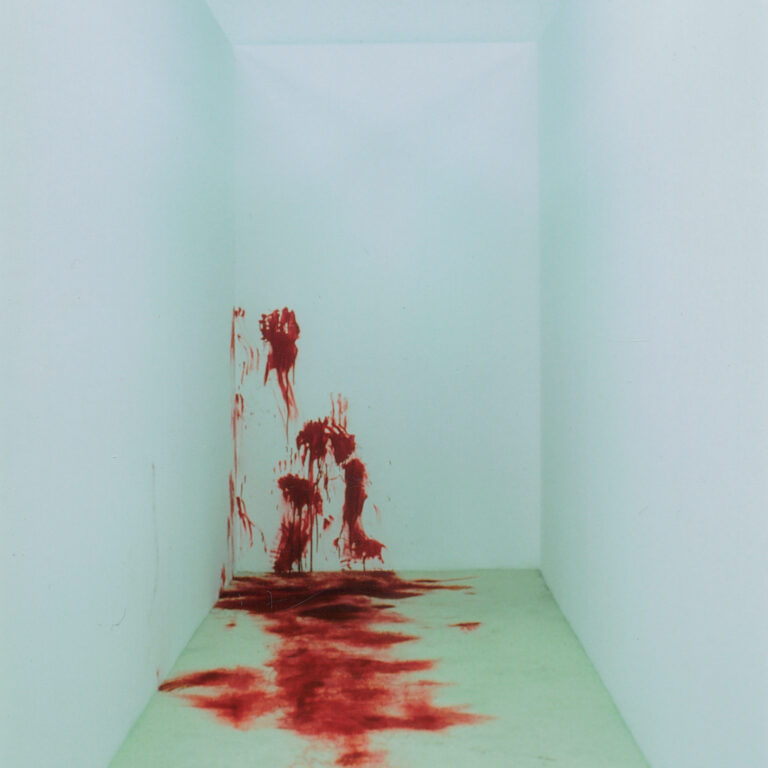
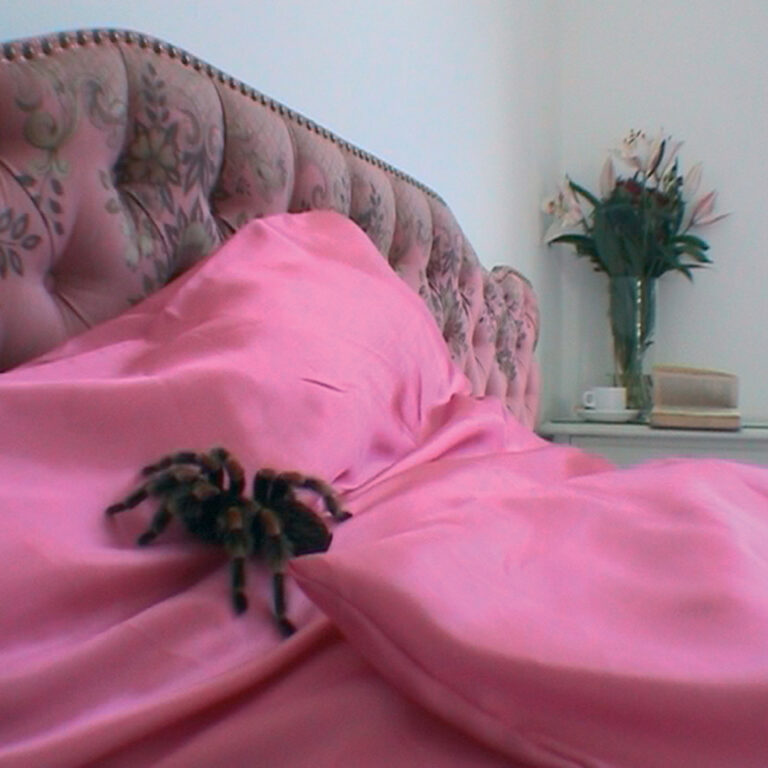
Evidence of crime and horrible mysteries from the past can be traced in Burska’s other works as well. A bleeding victim might have crawled along a white corridor (untitled, 2001), an enormous spider moves in an empty boudoir (Arachne, 2003), bloodstains cover the walls of a long-forgotten fort (untitled, 2001). Widely discussed by psychologists as well as historians, architectural memory became a real curse of the twentieth century. The painful memory of walls, old furniture, cellars resembles a scar that never completely heals. Time and again the wound is renewed and starts bleeding once more.
This problem is also reflected in Burska’s activity connected with sacred architecture. In her two projects developed in churches in Pogorzela (2002) and Frankfurt an der Oder (2004), the artist alluded to the best Christian tradition of artistic representations of passion and suffering. Stained glass windows covered with patches of red paint became an abstract story of martyrdom, sin and redemption. The bleeding temples were also a reminder of the dark chapters in the history of Christianity. They were a painful architectural stigma.
excerpt from the text Bloody Dew and Other Prophecies. On the Art of Bogna Burska by Sebastian Cichocki, catalogue Bogna Burska. Rainfall, published by Bytom Cultural Centre, 2006
installation, 2001/2002
installation, 2001/2002
Biała Gallery in Lublin, 2002
BWA Zielona Góra, Ujazdowski Castle Centre for Contemporary Art in Warsaw, 2001
Neuer Berliner Kunstverein, 2003
Wyspa Art Institute in Gdańsk, 2008
Trafostacja Sztuki w Szczecinie, 2020
Gdańsk City Gallery, 2021