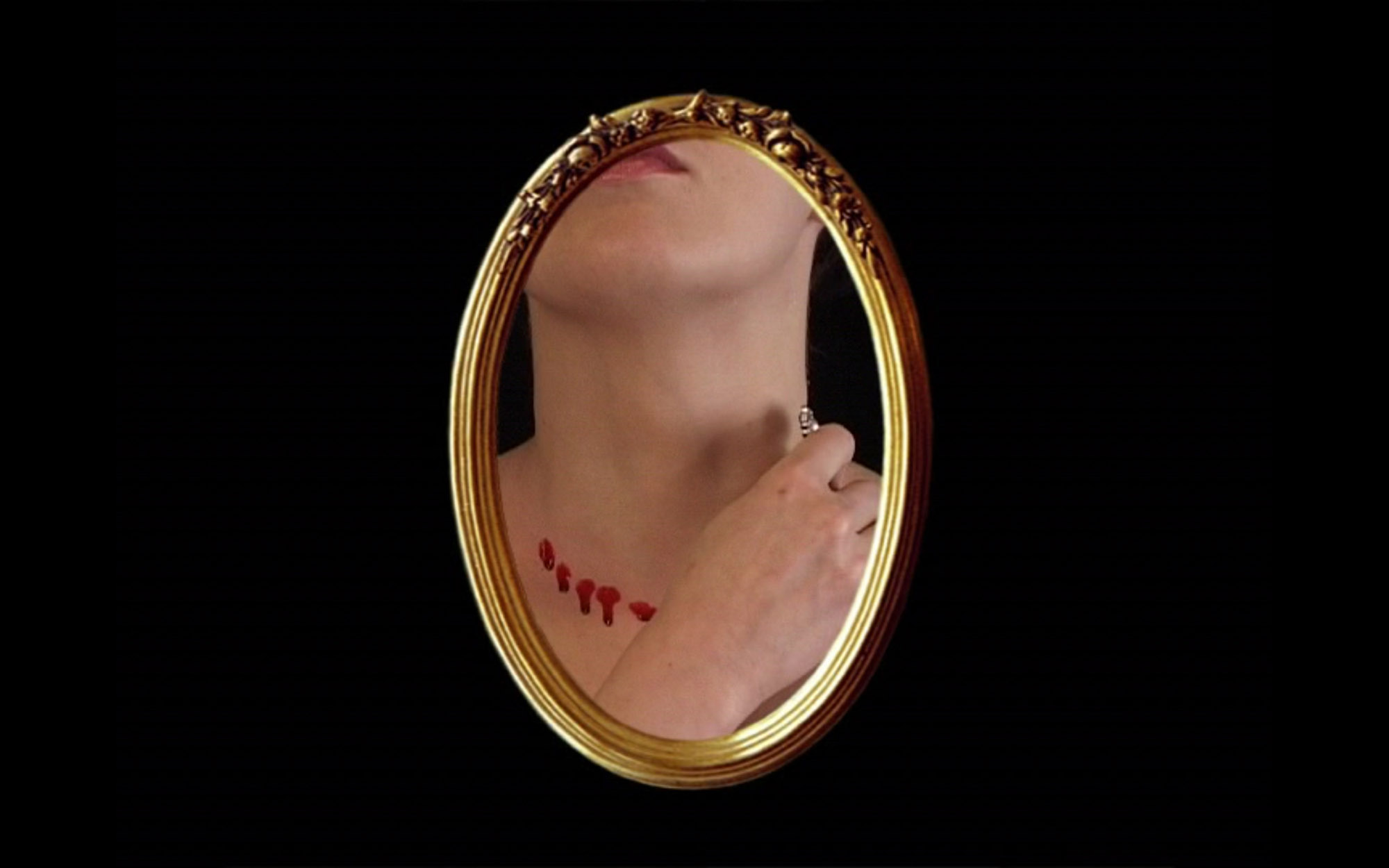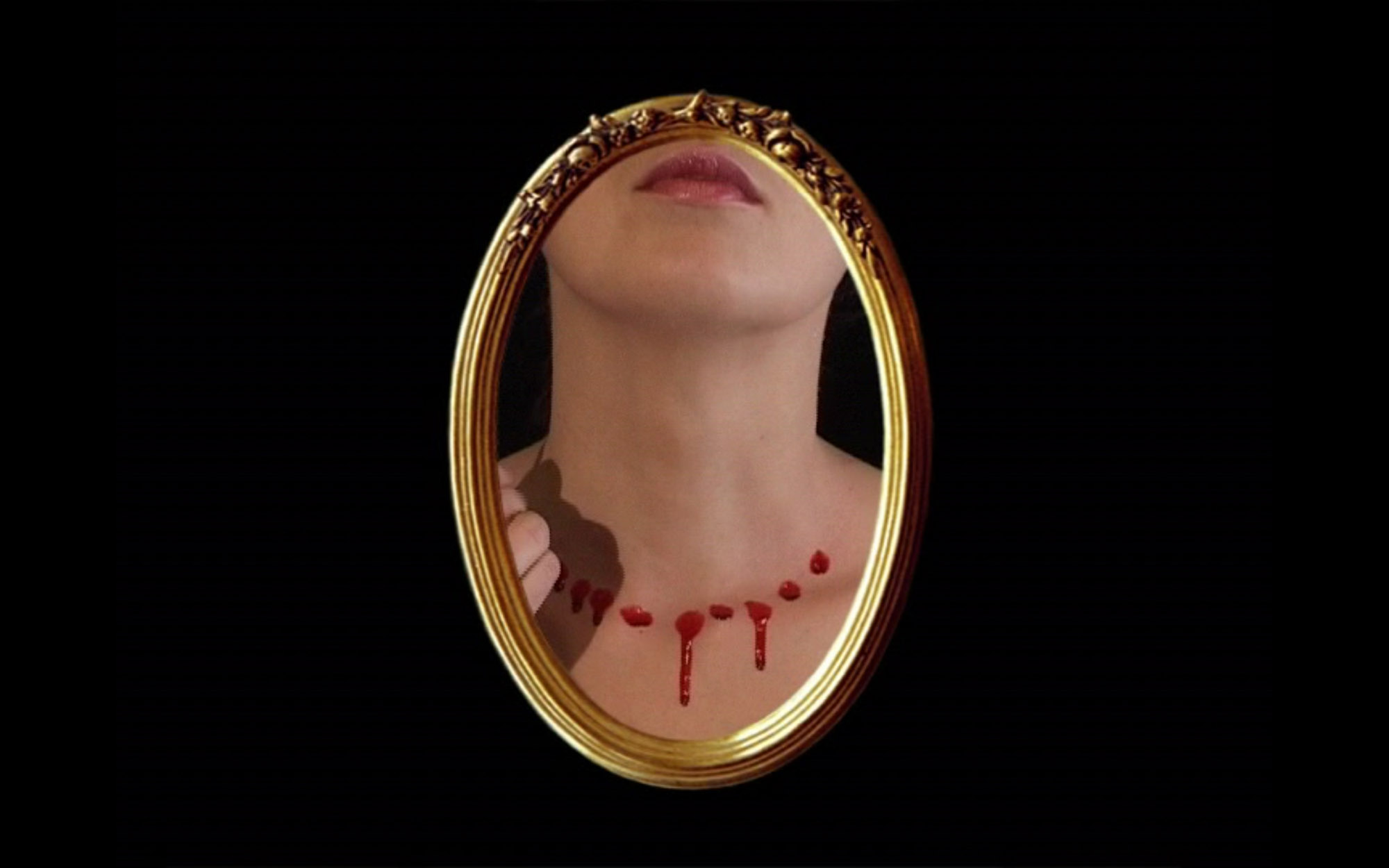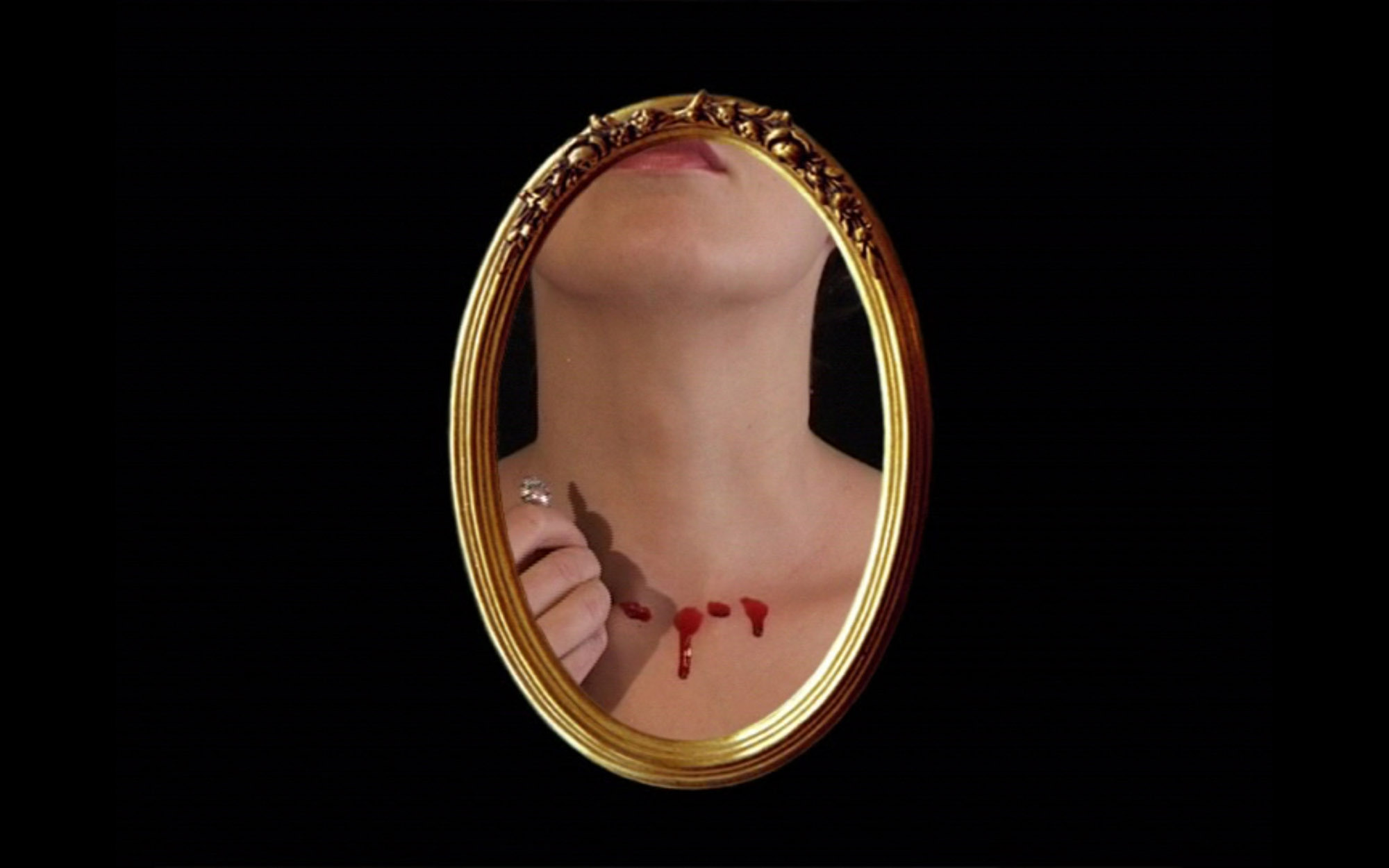
2006
video
duration: 6 min. 34 sec.
cinematography: Michał Januszaniec
music: Kordian Ronnberg
vocals: Wojciech Lewandowski – Faust’s aria from Mefistofele by Arrigo Boito
work in the Gdańsk Collection of Contemporary Art
Gretchen, Margot, Margarita.
Margarita received her name after Gretchen and was the great-great-great-granddaughter of Margot.
On Walpurgis Night in the Harz Mountains Faust had a vision:
(…) seest thou there
Standing far off, a lone child, pale and fair?
Slow from the spot her drooping form she tears,
And seems with shackled feet to move along;
I own, within me the delusion’s strong,
That she the likeness of my Gretchen wears.
(…)
Ay, verily! a corpse’s eyes are those,
Which there was no fond loving hand to close.
That is the bosom I so fondly press’d,
That my sweet Gretchen’s form, so oft caress’d!
(…)
How strangely doth a single crimson line
Around that lovely neck its coil entwine (…)
Perhaps at this moment Faust was recalling the jewels with which he would entice Margaret – his beloved Gretchen. Thanks to the endeavours and swiftness of the messenger Mephistopheles, the girl would find caskets in her press cupboard with glimmering trinkets which she would try on before the mirror, hiding from the strict glance of her mother. Faust’s beloved was named after Susanne Margarethe Brandt, executed in 1772 in Frankfurt for killing her child born out of wedlock, which she did „out of shame and fear of the people”. Gretchen was doomed with a similar lot; however, her soul was not ultimately condemned. During Walpurgis Night she was still alive, while her lonely lover was looking for her in the Harz Mountains.
On the exact same day of the exact same month; however, at least two centuries later, Margarita Nikolayevna was getting ready for Satan’s Great Ball, also referred to as the ball of a hundred kings or the spring ball of the full moon. She was to become its queen and hostess: „Firstly, it has become a tradition, (…) that the hostess of the ball must be called Margarita and secondly, she must be a native of the place where the ball is held. (…) You too, of course, are of royal blood.(…) If you were to ask certain of your great-great-great-grandmothers, especially those who had a reputation for shyness, they might tell you some remarkable secrets (…) I rather think that a certain queen of France of the sixteenth century would be most astonished if somebody told her that after all these years I should have the pleasure of walking arm in arm round a ballroom in Moscow with her great-great-great-great-great-granddaughter…” Margarita was washed in blood and rose oil, rubbed with leaves, dressed in shoes made out of pale rose petals, adorned with a diamond crown and a heavy chain. “Let the ball commence!” shrieked the cat in a piercing voice.
The above-mentioned queen of France is Marguerite de Valois, known as Margot. She was the daughter of Catherine de’ Medici and Henry II, sister of the kings of France: Francis II, Charles IX and Henry III (in Poland referred to as Henry of Valois). In 1572 she was married to Henry king of Navarre; however, their wedding celebration turned into the slaughter of their guests, later known as the St. Bartholomew’s Day massacre. Margot did not love her husband, but had feelings for Count La Môle who was unjustly accused and convicted for the participation in the plot against the life of Charles IX. Intending to beg her brother to show mercy for her lover, beautiful Margot put on a white dress of which the king was very fond. She also wore her best jewellery. Unfortunately, she was late – the poisoned king was already dying. Margot’s white dress was covered with smudges of her brother’s blood. La Môle was beheaded.
Bogna Burska 2006
Based on: Faust by J.W. Goethe, Libretto of Mefistofele: Opera in Four Acts by Arrigo Boito, The Master and Margarita by Mikhail Bulgakov, Queen Margot by Alexandre Dumas and the film Queen Margot by Patrice Chéreau.
Quotes from:
Faust, Joann Wolfgang Goethe, https://www.gutenberg.org/files/14591/14591-h/14591-h.htm#XXI (accessed on 02.08.2021).
Libretto of Mefistofele: Opera in Four Acts by Arrigo Boito, https://archive.org/details/librettomefisto01boitgoog/page/n5/mode/2up (accessed on 02.08.2021).
The Master and Margarita, Mikhail Bulgakov, translated from the Russian by Mirra Ginsburg, Grove Press, New York, 1967.
The Master and Margarita, Mikhail Bulgakov, translated from the Russian by Michael Glenny, Collins and Harvill Press, London, 1967 https://www.masterandmargarita.eu/estore/pdf/eben001_mastermargarita_glenny.pdf (accessed on 12.08.2021).