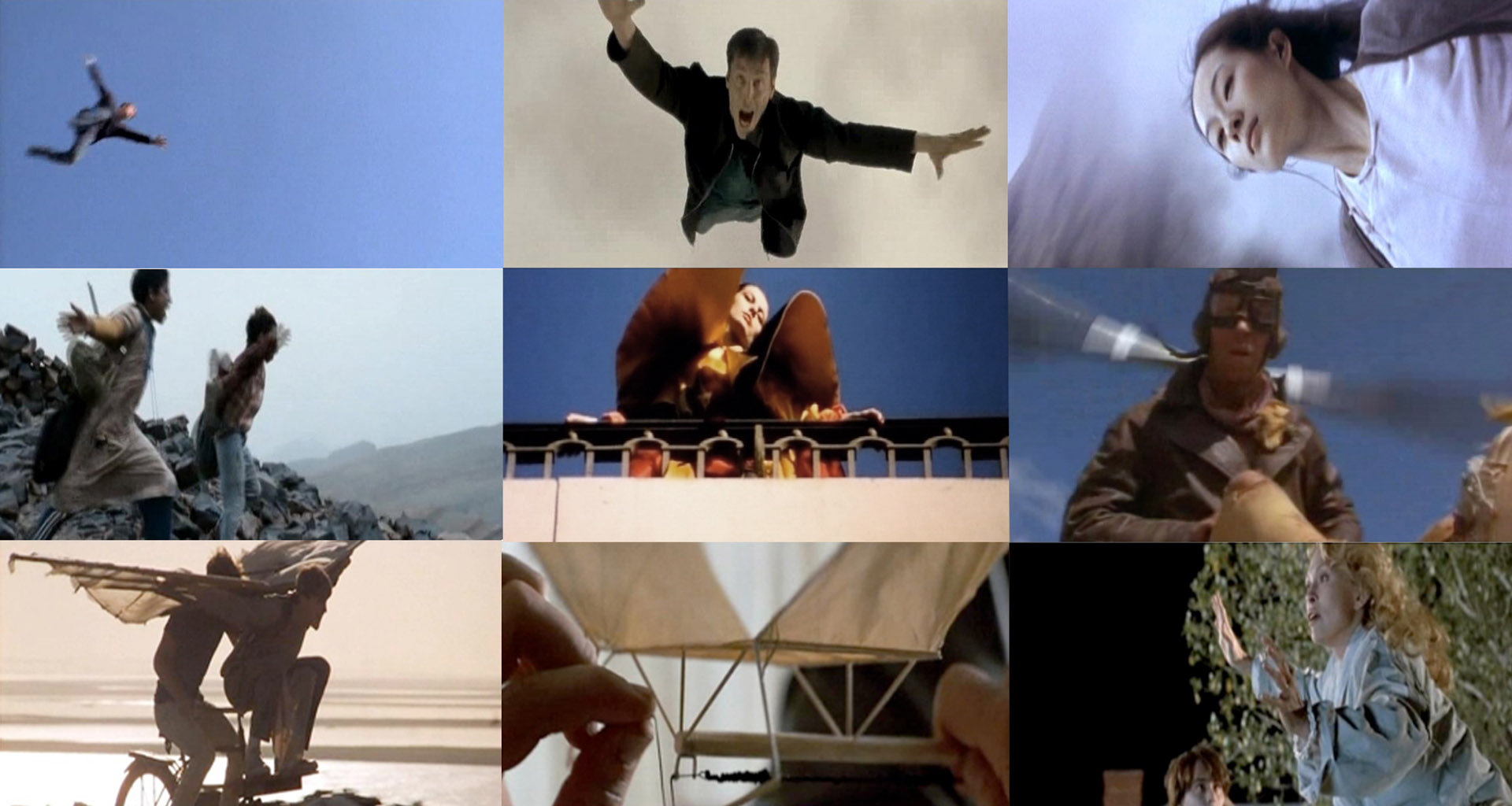
2006/2007
found footage video
duration: 11’50”
from the series Game with Moving Mirrors – Part Two
collaboration: Michał Januszaniec
K.W.: You used fragments of Arizona Dream in one of your works – the scene in which the characters tell each other how they would like to die. At least, it seemed to me to be like that when I watched this film many years ago. Now, I realise that they practically all speak about the same thing: a leap into a precipice, being smashed against the rocks, dissolved in the air – in a word: about flying, as it may be dubbed, for the lack of a better word. A moment later, the character of Crouching Tiger, Hidden Dragon tells the story about a certain rock: if someone jumps from it, their dreams will come true. He also talks about a man who jumped but was not smashed against the rocks, rather dissolved in the air instead, never to return. It is the state Buddhist monks would call
nirvana.
You called your film Wind.
B.B.: (…) The construction of the three films: Wind, A Heart So White and God is Vain, is based on the juxtaposition of two symmetrical and visually similar motifs which, in spite of this, have different or even contradictory meanings – one of them pertains to making/becoming dirty, the other – purification. The same situation applies to “flying”. There are two stories conjoined: a dream of flying and a dream of death by jumping. On the visual level, they were supposed to connect attempts at taking off into flight and suicidal leaps. I was curious what the difference was between them and what the outcome of joining them together would be.
An important scene in this film is Mrs. Dalloway’s monologue, when she stands in a window and ponders Septimus’s suicide, having just learned that he has killed himself by jumping. Mrs. Dalloway has mused on suicide too, but Septimus’s death somehow frees her from this desire. This monologue was my first inspiration. Two similar things, and the paradox they contain – whenever you try to take off, you risk your life; whenever you try to kill yourself by leaping from a high point, you are airborne for a while. The film is an attempt to search for images and what it is possible to do with them – to check where they meet, where they cleave apart – and to build something on the basis of symmetry. It is also a work about the quest for liberation, as this issue is also common to the two motifs here.
excerpt from the interview conducted by Kamila Wielebska, Fatal Infatuations Will Set Us Free – A Conversation with Bogna Burska, catalogue Films. Bogna Burska, ed. Aleksandra Grzonkowska, published by Wyspa Art Institute, Bunkier Sztuki Gallery of Contemporary Art, BWA Zielona Góra, and the Academy of Fine Arts in Gdańsk, 2014
sources:
Abre los Ojos reż. Alejandro Amenabar
Arizona Dream reż. Emir Kusturica
Babel reż. Guillermo Arriaga
Batman Begins reż. Christopher Nolan
Birdy reż. Alan Parker
Bram Stoker’s Dracula reż. Francis Ford Coppola
Brokeback Mountain reż. Ang Lee
Casino Royale reż. Martin Campbell
Craft reż. Andrew Fleming
Devil’s Advocate reż. Taylor Hackford
Gerry reż. Gus Van Sant
Happy Together reż. Wong Kar-Wai
Hudson Hawk reż. Michael Lehmann
Immortel. Ad vitam, reż. Enki Bilal
King Arthur reż. Antoine Fuqua
La Mala educacion reż. Pedro Almodovar
Lolita reż. Adrian Lyne
Mad Max 2: The Road Warrior reż. George Miller
Matador reż. Pedro Almodovar
Matrix reż. Andy Wachowski, Larry Wachowski
Memoirs of a Geisha reż. Rob Marshall
Mr. & Mrs. Smith reż. Doug Liman
Mrs. Dalloway reż. Marleen Gorris
Mulholland Dr. reż. David Lynch
Nosferatu: Phanton der Nacht reż. Werner Herzog
Picnic at Hanging Rock reż. Peter Weir
Riders reż. Gerard Pires
Scream Of Stone reż. Werner Herzog
Serpico reż. Sidney Lumet
Spider-Man reż. Sam Raimi
Star Wars: Episode I The Phantom Menace reż. George Lucas
Star Wars: Episode III Revenge of the Sith reż. George Lucas
Superman Returns reż. Bryan Singer
The Figitive reż. Andrew Davis
The Million Dollar Hotel reż. Wim Wenders
Twisted reż. Philip Kaufman
Untouchables reż. Brian De Palma
Wo hu zang long reż. Ang Lee
Ying xiong reż. Zhang Yimou